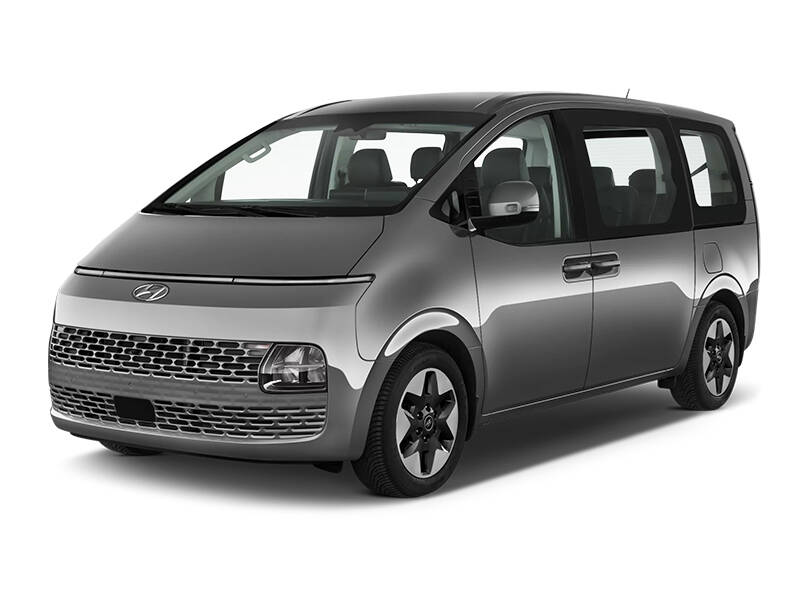
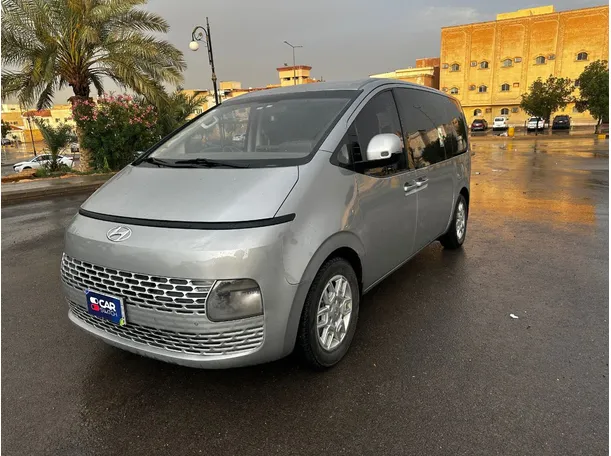
The Hyundai Staria brings a striking, space-age design to Saudi Arabia's MPV segment — a vehicle built for families and executive transport alike, with a wide, airy cabin and a silhouette unlike anything else on the road. Prices in KSA start from SAR 135,444 for the Luxury (9 Seater), with the Luxury (7 Seater) topping out at SAR 184,434.
The KSA Staria is powered by a 2.2 L diesel engine producing 177 bhp, paired with a Manual gearbox — a torque-rich combination well-suited to the longer inter-city drives common across the Kingdom. The Luxury (9 Seater) seats up to 9 passengers and represents strong value for large-family or fleet use, while the Luxury (7 Seater) offers a more intimate, premium configuration with upgraded cabin trim and comfort features. The move from the nine-seater to the seven-seater buys each passenger noticeably more personal space and a more luxurious finish.
Pros: the diesel powertrain delivers strong torque for overtaking on long Saudi highways, and the elevated seating position gives all passengers a commanding view. The Staria's lounge-style cabin is one of the most comfortable ways to move a family across large distances in this price range. Cons: the Manual gearbox may feel dated to buyers expecting an automatic in a vehicle at this price point. The fuel economy for the diesel variant is not formally published, though real-world efficiency on Saudi highways should be reasonable given the engine's torque characteristics.
Market resale data for the Staria in Saudi Arabia is still forming given its relatively recent arrival. Buyers focused on long-term value should note that Hyundai's broader lineup holds up respectably in the Saudi used-car market — a positive indicator for this nameplate as supply matures.
The Toyota Hiace, Nissan Urvan and Ford Transit are the natural alternatives here, sitting in the same segment at comparable prices.
How much does the Hyundai Staria cost in Saudi Arabia?
Seat count and trim move independently here, so the cheapest car is not the most basic one. SAR 135,444 buys the Luxury (9 Seater); the working van version sits above it; and SAR 184,434 buys the Luxury (7 Seater), which carries fewer people in considerably more comfort. Decide what the vehicle is for before you look at where each version sits on price.
Which Staria is the one to buy?
The nine-seat Luxury is the value choice and covers most needs — maximum capacity, full trim, lowest price of the three. The van version is for businesses that need the load area more than the seats. The seven-seat Luxury is the one to take only if the vehicle is carrying your family rather than working for a living, because you are paying more for fewer places.
Hyundai Staria or Toyota Hiace?
The Staria is the better vehicle for carrying people: quieter, far more comfortable over long distances, better equipped, and four-wheel drive where its rivals are not. That matters on a nine-seater doing inter-city runs. The Toyota Hiace is the tougher commercial workhorse with the stronger resale and deeper parts supply. The Nissan Urvan is the cheaper way to do the same job.
What does a Hyundai Staria cost to run in Saudi Arabia?
Diesel economy is the reason to buy one — a 2.2-litre turbodiesel moving nine people uses far less fuel than a petrol vehicle of this size would. Diesel servicing is more specific, though: filters and injectors follow their own schedule, and the authorised network is the safer route for that work while the vehicle is under warranty.
Does the Hyundai Staria hold its value, and what should you watch for as it ages?
Below the class — about 43% of its value after five years, against roughly 52% for Korean cars in the Kingdom, the trade-off for a model still establishing itself here. The Starias reaching CarSwitch for inspection are only at a median of around 53,000 km so far, still early for a vehicle built for high-mileage duty. How one was worked matters more than how far: sliding doors, seat rails and rear air-conditioning are the class wear points, all covered by the inspection report on that specific vehicle.


 Hi Guest